Being a Machine Learning expert, I created a smart Rizz AI chatbot that uses advanced AI algorithms to connect people, and its GPT powered matchmaking algorithm design to help users to find and communicate with friends or partners based on what they like or are good at!
It understands questions like:
“What are my hobbies and interests?”
“What type of personality do I get along with best?”
“What kind of friend am I looking for – someone similar to me or someone different?”
Basically, chatbots are designed to assist users on various platforms. These chatbots use natural language processing (NLP) and machine learning algorithms to simulate human conversation and respond to user queries in a way that facilitates communication.
Dating assistants like Rizz AI are essentially AI chatbots. To understand the technical process, required features, and potential business aspects of creating such an application, you first have to learn the basics of artificial intelligence and the Python programming language.
The architecture of creating a Rizz chatbot can be divided into design, building, analytics, and maintenance.
AI dating app chatbot development is the process of creating a Rizz-like chatbot for the purpose of interaction between the user and the virtual dating assistant.
Rizz AI chatbot developers define the chatbot’s personality, the questions that will be asked to the Rizz lovers (end users), and the overall interaction. An important part of chatbot development is also centered around user testing.
The fundamental processing of Chat-Bot
As shown in the figure below (flowchart), the chatbot operates in three main stages.
First, it receives input from the user as a message.
Second, it processes the input and selects the response generated by the logic adapters with the highest confidence value.
Third, it returns the response to the user, providing the most confident match.
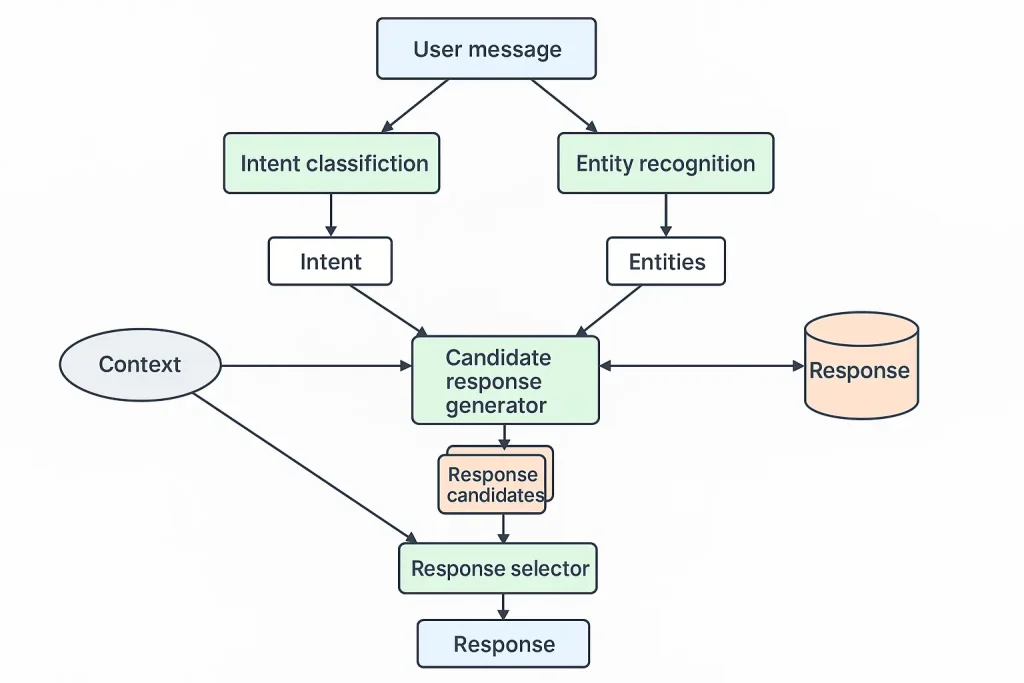
Intents: Intents refer to goals of the customer;
Entities: Entities used to add values to search;
Candidate response generator: generates a response for the user to give to respected questions;
Context: refers to collaborative act;
Response: refers to Chat-Bot replies.
The general process of building a Chat-Bot is:
1. Preparing the dependencies.
2. Import classes.
3. Create and train the Chat-Bot.
4. Communicate with python Chat-Bot.
5. Training the python Chat-Bot with a corpus of data.
The Technology Stack use for building Rizz AI
Being an AI specialist, research shows that top chatbots are often built on specific frameworks rather than Streamlit, and they are usually programmed in Python to prevent repeating false information.
A primary goal of the technology stack when building a chatbot is to process complex queries and provide accurate responses to users in real time.
The quality and accuracy of AI Rizz chatbots can vary depending on how they are trained and programmed, raising concerns that their output may sometimes include inappropriate suggestions or mismatched connections due to poor prompting.
“We have seen the way AI assistants can either fabricate results or give biased answers after human coders specifically change their instructions,” Angie Holan, director of the International Fact-Checking Network, told AFP. Source.
That’s why choosing right technology stack is important for the combination of backend, frontend, cloud based servers, and AI tools that determine your app’s performance, reliability, and long-term success.
A strong tech stack ensures your dating assistant can:
1. Handle real-time conversations without delays.
2. Integrate seamlessly with AI engines such as Large Language Models (LLMs).
3. Leverage Natural Language Processing (NLP) for understanding intent and tone.
4. Use Machine Learning (ML) to personalize recommendations and adapt over time.
Why is this important? Because users typically expect quick responses from AI dating apps. There is zero tolerance for slow response times, as they create a poor user experience and may lead users to switch to another app.
That’s why choosing a result oriented tech stack can improve performance and user satisfaction, which are important factors for user friendly results.
Backend Frameworks for AI Dating Assistants
In many cases, chatbot design and development strategies depend on the target audience’s needs.
The backend (server-side) logic of any chatbot acts as a control center that handles user queries, retrieves context, calls the LLM, and sends responses to the frontend. Choosing the right backend technology is important because it directly impacts scalability, response speed, and how well the system integrates with AI models.
Popular Backend Frameworks
1. Node.js: It is an open-source, cross-platform JavaScript runtime environment and server-side JS environment that allows developers to execute JavaScript code outside of a web browser. Node.js is basically designed for processing multi tasks simultaneously. It can easily manage back-and-forth chat conversations without being server down. When building a dating app like Rizz AI, Node.js is really helpful. It smartly handles multiple tasks at once instead of doing them one after another.
2. Python (with Django or Flask): Python was one of the most popular languages before ML started taking off. It is a multi-paradigm language that’s easy to learn and has a very large user community. The number of libraries that work with Python is huge, so you can do almost anything you want. And it’s one of the de facto standard languages in fields like data science, scientific computing, and AI.
It has many libraries that solve daily problems super quickly. Starting with the little things, to large complex ML problems.
Python has the largest data science/ machine learning ecosystem likely due to how simple and flexible the language is due to its libraries (TensorFlow, PyTorch, and spaCy). Also used as a back-end language or to write simple scripts to automate a process of dating apps.
It is easy to use and it is very versatile for server side web development and automation work.
Dating assistant uses Large Language Models (LLMs) for generating human-like text, So Python comes with easy integration with LLM APIs (including GPT-based ones) and make applications human friendly.
Frontend & Mobile Development Frameworks
Frontend coding turn designs into actual interactive pages, handles state/data from APIs, ensures the site works across devices, optimizes performance, and fix bugs that affect users. Basically, anything the user sees or interacts with usually runs through frontend.
Day to day, it involves building and maintaining the UI, making sure the site works across devices, handling state, API calls, accessibility, performance, and often collaborating with designers and backend developers to connect everything. It’s as much about function as it is about visuals.
There are two famous frameworks belong with frontend.
1. React native
2. Flutter
React Native is easy to integrate with APIs that deliver LLM-powered responses or NLP-driven results, since it supports JavaScript-based SDKs.
However, Flutter is generally considered more popular than React Native. Flutter performs better on Android, while React Native tends to perform better on iOS. This is why Flutter works well for apps where personalization and recommendation models (Machine Learning (ML)) need to be presented in a more user-friendly way.
Building the Conversation Engine – NLP for Flirty Chats
Why NLP Matters for Flirty Chats
NLP-natural language processing is a branch of artificial intelligence (AI) that focuses on the interaction between computers and humans using natural language. It involves teaching computers to understand, interpret, and generate human language in a way that is both meaningful and contextually relevant.
Real-world examples:
AI dating assistants like Rizz use NLP techniques to understand your questions and commands, even if you speak naturally. They often focus on giving witty replies — but what makes those replies actually sound human is Natural Language Processing (NLP).
Let see how NLP algorithms work:
1. Tokenization: Breaking down a sentence or a paragraph into smaller units called tokens (words or phrases).Example: “I love NLP” → [“I”, “love”, “NLP”].
2. Sentiment Analysis:Definition: Determining the sentiment (positive, negative, neutral) expressed in a piece of text.Example: “I love this product! It’s amazing!” → Positive sentiment.
NLP enables computer to understand communication between humans and chatbots. It connects the AI model and users, allowing it to identify when a user is being playful or joking, and to guide the conversation toward a more respectful tone when needed.
Developers aim to build better NLP models that understand human psychology, mood, and intent behind a message before generating a response. This is especially important in flirty chats, where users want engaging Rizz-style responses. For example:
“You’re trouble 😏” might be playful, not hostile.
“You didn’t reply last night” could signal mild disappointment, requiring a softer response.
“Netflix or dinner first?” is both a question and a hint at interest.
NLP Fundamentals for Dating Assistants
Before building a conversation engine for flirty chats, you first need to learn the basics of NLP components that allow chatbots to communicate using human language. The whole system is based on building blocks that ensure your AI dating assistant not only generates responses but also understands human context.
1. Intent Detection
Intent detection identifies the purpose behind a user’s message. Is the person asking a question, making a joke, flirting, or expressing frustration?
For example:
“What’s your type?” → curiosity.
“You’re cute 😏” → flirting.
“This app is annoying” → complaint.
A proper intent-based query ensures the model responds appropriately, keeping conversations aligned with user expectations.
2. Sentiment Analysis
Sentiment analysis helps detect whether a message is positive, neutral, or negative. If someone sends a lighthearted message, the NLP based assistant can respond in a friendly tone, but if the message is negative, the AI will handle it according to its designed model.
3. Named Entity Recognition (NER)
NER extracts key information like names, locations, or dates. This allows the model to personalize conversations.
For example, if the user says, “I had sushi in Tokyo last year,” the assistant can reference Tokyo or sushi in later replies, creating a sense of memory and connection.
By combining intent detection, sentiment analysis, and NER, developers can create more intelligent chatbots that understand context, emotions, and important details. his helps the chatbot provide more relevant and personalized responses.
Tools & Libraries for NLP in Dating Apps
As you know, ARTIFICIAL intelligence (AI) is one of the most consequential technologies today.
AI is data resource-hungry, so building a conversation app like Rizz requires a well-planned and elaborate system.
A rise in AI deployment means a rise in the number of NLP tools, libraries, frameworks, and APIs that can improve AI’s potential in terms of critical thinking.
Here are listed few NLP tools and libraries below.
1. spaCy
Best for: lightweight NLP tasks like tokenization, part-of-speech tagging, and entity recognition.
Why it works in dating apps: spaCy can quickly identify names, dates, or locations mentioned in chats, helping personalize replies (e.g., remembering someone’s favorite food).
2. Hugging Face Transformers
Best for: advanced NLP with pre-trained models (BERT, GPT, RoBERTa, etc.).
Why it works in dating apps: Developers can fine-tune models for intent detection, tone analysis, or flirty style transfer. Hugging Face also provides pipelines for sentiment analysis that are responsible for giving results user friendly.
3. Google Dialogflow
Best for: fast prototyping of conversational flows.
Why it works in dating apps: Built-in intent recognition and multilingual support make it easy to deploy an MVP. It’s less flexible than custom models but great for early-stage projects.
4. Rasa
Best for: open-source, customizable conversational AI.
Why it works in dating apps: Developers have full control over intent classification, entity extraction, and dialogue policies. Perfect for building AI that requires nuanced flirty interactions and safety layers.
5. Cloud AI Services
AWS Comprehend, Azure Cognitive Services, Google Cloud NLP: These provide robust APIs for sentiment analysis, entity extraction, and text classification. They’re scalable and enterprise-ready, ideal if your dating app expects heavy traffic.
In general, most Rizz-like assistants use a hybrid approach: lightweight tools like spaCy for fast text pre-processing, Hugging Face for advanced NLP tasks, and a hosted cloud NLP service for flexible scaling. Pairing all of these with Large Language Models (LLMs) allows the system to generate witty, intelligent, context-aware, and friendly flirty responses.
Making a secure and private Chat-Bot
Dating apps are more prone to cyber attack, especially those which are powered by AI, because users share data in form of text messages, communication logs, and even profile pictures. They also share personal interests, daily routines, preferences, and sometimes sensitive emotional data. If this data is misused, exposed, or manipulated, it can seriously damage the credibility of the entire platform.
That’s why a Chat-Bot needs to have strong protection from day one. Clients count on high quality safety protocols along with https and HTTP metadata linked to any net channel that makes use of their non-public facts.
Anything which isn’t always a relaxed web page and clients will flat-out refuse to apply Chat-Bot.
Need to make sure that safety features are in location, such as stop to-forestall encryption, component authentication, biometric authentication, and authentication timeouts. Behavior finding out of Chat-Bot through manner of jogging penetration exams and API safety tests.
Natural Language Processing (NLP), Large Language Models (LLMs), and Machine Learning (ML) are programmed in such a way that it trains models based on dating application. Although users data becomes more sensitive to leak with emerging tech so under cyber professionals it should be kept secret.
Data Privacy Principles
Developers need to build a trustworthy AI dating assistant, and must keep privacy as a design principle, not an afterthought. There must be strict surveillance towards users data. What’s necessary to collect and protect is very much crucial.
Compliance with Global Regulations: Privacy isn’t just an ethical duty—it’s a legal one. Regulations like GDPR (Europe), CCPA (California), and other data protection laws require apps to provide features like data deletion on request and user data portability. Staying compliant avoids costly penalties and builds global credibility.
Security Layers for AI Dating Assistants
1. Secure Authentication
Two-Factor Authentication (2FA): Adds a second step beyond passwords, such as SMS OTP codes or Google authenticator apps. This prevents unauthorized access, even if credentials are leaked.
OAuth & Social Logins: Secure integrations with platforms like Google or Apple streamline login while offloading authentication risk to trusted providers.
2. Encrypted Communication
Transport Layer Security (TLS/SSL): Ensures all messages between app and server are encrypted in transit.
End-to-End Encryption (E2EE): Especially critical for AI-driven chat features, where private conversations should only be visible to participants—not even the platform should access the raw text.
3. Cloud Security Best Practices
Most AI dating apps run on platforms like AWS, Azure, or Firebase. To maintain trust, developers should:
1. Use role-based access control (RBAC) to restrict who can access sensitive data.
2. Regularly rotate API keys and credentials.
3. Enable cloud-native encryption at rest to protect stored profiles and conversations.
4. Run security audits and penetration tests to check vulnerabilities before hackers attack.
How Much Does It Cost to Build an AI Dating App?
The cost of development depends on several factors:
1. Feature Set
A basic app with profiles and chat, will cost far less than one with AI-driven flirty conversations, LLM-powered chatbots, video calls, and advanced ML-based matchmaking.
2. Technology Stack
Your choice of backend (Node.js, Python, Django), frontend (React Native, Flutter, Swift/Kotlin), and cloud services (AWS, Firebase, Azure) directly impacts development time and cost. Adding Natural Language Processing (NLP), Large Language Models (LLMs), and Machine Learning (ML) further increases expenses due to specialized expertise and compute requirements.
3. Team Composition
An in-house team in the U.S. or Europe may cost 3–5x more than outsourcing to regions like Eastern Europe, India, or Southeast Asia. The team usually includes:
1. Developers (backend, frontend, mobile).
2. AI/ML engineers for chatbot and recommendation features.
3. UI/UX designers.
4. QA testers.
5. Project managers.
4. Scope: MVP vs. Full-Scale App
MVP (Minimum Viable Product): Costs less, focuses on testing core features with real users.
Full-scale launch: Requires heavy investment in scalability, advanced AI, and security compliance.
In short, the cost to build an AI dating app can range widely—from a lean MVP under $50,000 to an enterprise-grade app exceeding $500,000. The key is knowing which cost drivers matter most to your goals and budget.
Core Cost Components
When estimating the budget for an AI dating app, it helps to break costs into five main categories. Each plays a crucial role in building and managing both the user experience and the overall price tag.
1. Development Team
The largest portion of the budget usually goes to your team. A typical AI dating app requires:
1. Backend developers (server logic, databases, APIs).
2. Frontend/mobile developers (React Native, Flutter, Swift/Kotlin).
3. AI/ML engineers (LLMs, NLP, ML-driven matchmaking).
4. UI/UX designers (intuitive interfaces, user flows).
5. QA testers & project managers.
So estimated Cost range: $25,000 – $150,000 depending on team location and complexity.
2. Technology Stack
1. Backend frameworks (Node.js, Python, Django)
2. Frontend frameworks (React Native, Flutter for cross-platform; Swift/Kotlin for native apps)
3. Cloud hosting (AWS, Firebase, Azure)
Each choice affects speed, scalability, and costs. For example, Firebase may be cheaper for small MVPs, but AWS/Azure provide better enterprise-level scalability.
Cost range: $5,000 – $30,000 for setup and integration.
3. AI Integration
This is the differentiator between a basic dating app and an AI-powered one. Costs here cover:
1. Natural Language Processing (NLP): Enables chat understanding and tone detection.
2. Large Language Models (LLMs): Power flirty conversation engines.
3. Machine Learning (ML): Personalizes matches and recommendations.
If you use pre-trained models (e.g., GPT APIs, Hugging Face), costs are lower. Custom training models requires far higher budgets.
Cost range: $20,000 – $100,000+ (depending on custom vs. API).
4. UI/UX Design
A dating app must be visually appealing and frictionless. Investing in clean design reduces churn. Includes:
1. Wireframing & prototyping
2. User testing
3. Visual branding
Cost range: $5,000 – $25,000.
5. Privacy & Security
Since dating apps process highly sensitive data, compliance and encryption are non-negotiable. This includes:
1. End-to-end encryption for chats.
2 Secure authentication (2FA, OAuth).
3. GDPR/CCPA compliance.
4. Regular security audits.
💲 Cost range: $10,000 – $50,000+.
Frequently asked questions
Conclusion
Machine learning (ML), deep learning, and neural networks are the three fundamental technologies behind Rizz AI bot. These AI technologies help to create personal, safe, and engaging features that users expect from modern dating apps.
From choosing the right technology stack to designing NLP-driven conversation engines, ensuring privacy/security, managing costs, and making ethical design choices, these key decisions significantly impact user trust and long-term success.
Large Language Models (LLMs), Natural Language Processing (NLP), and Machine Learning (ML) can help developers build better chatbots for dating apps like Rizz AI. These technologies make it easier for people to have smooth and natural conversations online.
These advanced tools have the potential to make dating chatbots more secure, accessible, and user-friendly. They can help users communicate better and feel more confident when talking to others.
If developers invest in the right technology and training, AI-powered dating apps could help people overcome common challenges they face when trying to connect with each others. The technology exists today – now it’s up to users and developers to make the most of these opportunities.